Is case analysis fundamentally intractable? Or can legal software be improved? I ran a small case study to find out.
Some problems can't be solved by crunching more data or coming up with a better algorithm.
I’m a senior software engineer with a long-time interest in law, including working for my local public defender’s office to get real experience. I’m applying to law school this fall.
In my work, I’ve had to tell people that they now have a bench warrant because they forgot their court date. I’ve had to tell them that their lawyer cannot see them. I think we sometimes forget how often our current system fails people and that the consequences can be dire. We forget, as Robert Cover puts it, that legal interpretation “takes place in a field of pain and death.”
I believe we can improve. I believe that improvement can be, in part, facilitated by software.
People seem to dislike this idea, and the reaction seems to be based on a false dichotomy: either law is about making complex human choices OR law is reduced to simple rules.
In other words, either someone is a practicing lawyer, who knows that law is about choice and human discretion, that even the choice of what facts to include and how to word them is fraught with consequence, or someone is an outsider who believes that if only we just tidied up a bit, got a little more scientific, law would be much easier. Legal software, in any form, is automatically categorized as the latter.
I think this is because people don’t know software. They wrongly believe that software inherently necessitates a mechanistic view of law, a rule-based, significant simplification of law’s nuances. They believe that software simply is simplistic.
For now I want to plant a flag: I think it’s very possible to be a legal realist and believe that law is contradictory and complex and every aspect of it full of human choices, and to also believe that the current legal software can be vastly improved upon.
A final note in this age of AI: I did the writing and analysis in this piece. Claude Fable 5.1 created the charts at my request, provided thoughtful insight, checked my work, and wrote the code.
The Challenge
On Bluesky, lawyer Mike Dunford wrote:
1/2LLMs are still bad at critical aspects of case analysis. As in the ones where you figure out how the case fits in with other cases, whether it's been silently overruled, or whether it's now a disfavored minority view. LLMs are also really bad at things like identifying the holding of a case.
Sep 13, 2026, 6:35 PM2/2And they're bad at those things for structural reasons. It's an intractable problem, at least so far, and it's likely to remain so, because it requires a lot that is very much beyond the text of the documents.
Sep 13, 2026, 6:35 PM
Putting LLMs aside, was it really true that this was an intractable problem, that none of these things could be determined from the text?
Due to my work in legal tech, I knew there were indicators from the text alone. Not the text of the single opinion itself, but the texts as a whole, including PACER documents, footnotes and citations. We could learn things from how a legal doctrine was referred to over time, and how an opinion was cited and by whom. Bluesky’s character limit doesn’t allow for nuance, but I tried to explain:
1/2"silently overruled," "disfavored minority view," "identifying the holding of a case."
You can derive these from the texts. Something silently overruled won't be often recently cited. Same for a disfavored minority view, not as highly cited (also may be explicitly mentioned.) A holding is often...
Sep 13, 2026, 6:41 PM2/2A holding is often what the case is cited for by other opinions.
None of this is insurmountable. It just requires having good data and building good software products.
Sep 13, 2026, 6:41 PM
I said, specifically, that one indicator of whether something has been silently overruled is whether it has been cited recently or not. If something is still often cited, it is more unlikely to have been overruled compared to something that historically was often cited but no longer.
Sure, let's be very specific. Let's say that various Courts of Appeals in CA used to often cite a specific case for a specific proposition, and in the past ten years, no longer do.
We don't know for sure why, but that data alone indicates something that should make us cautious.
The Experiment
My statements were met with skepticism, so I offered an experiment. We could identify some examples of silently overruled cases, and see if there are indicators in the text itself. Specifically, I said that one indicator would be if a case had been often cited for a specific proposition, but no longer is.
Mike provided a single starting example: Warner Bros. Pictures, Inc. v. Columbia Broadcasting System, Inc., 216 F.2d 945 (9th Cir. 1954), the “Sam Spade” or “Maltese Falcon” case. He said it was “most definitely not good law, but I’m pretty sure isn’t red-flagged anywhere.”
1/3Technically, legally, it still is good law for the core proposition - the 9th has never formally repudiated it, SCOTUS has never examined the primary question (whether fictional characters receive copyright protection). They just stopped applying that test and apply a different, inconsistent one.
Sep 13, 2026, 9:07 PM2/3You can kind of trace the shift away, but you have to be very familiar with that area of law to do it. And I could not - despite knowing this particular area about as well as anyone can - put a finger on an exact date or case and say "here's where it was silently overruled."
Sep 13, 2026, 9:08 PM3/3And, as I think about it, I think the 9th actually tried to handwave that it's still viable in 2020, but I can't really remember the specifics. Just that the court's analysis on that point was incoherent as shit.
Sep 13, 2026, 9:14 PM
Alright, we have our starting point.
If Mike were right, it would be an “intractable problem” that “requires a lot that is very much beyond the text of the documents.”
If I were right, there would be certain propositions that the Sam Spade case was no longer cited for. And beyond that, there would be specific things we could observe from the text itself that would indicate it had been silently overruled.
A Quick Note on Indicators
Yesterday, when I drove my car, my low tire pressure indicator went off. Low tire pressure indicators don’t tell you why you have low tire pressure, but they tell you that you should probably check your tires. That’s the purpose of an indicator.
An indicator is not a rule, and shouldn’t be confused for one. If someone tried to argue that low tire indicators are worthless because sometimes you have a nail in your tire that seals the hole and thus the indicator doesn’t go off (a false negative) or that sometimes you have low pressure because of temperature changes (my situation, a false positive for nails), we would think that person is misguided. An indicator is a signal, possibly one of many, and is evaluated in context by design.
There’s no reason to believe that indicators reduce important human discretion or human choices. In this case, seeing the indicator gave me the opportunity to check and fill my tires, something I wouldn’t have done otherwise. It increased my choices by giving me information I could work with.
The alternative, manually checking my tires every day before work, might build character or give me a closer relationship to my car, but generally it would be a waste of time, because the indicator is useful for its purpose. This is software at work.
Gathering the Texts
If you’re Westlaw or LexisNexis, you start from a huge advantage as a legal tech company: you have the texts of every opinion already (in many cases, because you had a monopoly on publishing them). I wouldn’t be able to use either because their terms of service disallow commercial use, so I would have to start by gathering the relevant texts myself.
Since the Sam Spade case was a Ninth Circuit case, I was primarily interested in other Ninth Circuit opinions, any peer circuit opinions, if the Supreme Court had ever chimed in, and how the district courts within the Ninth acted.
I started with CourtListener, an incredible (but not yet complete) public repository of case law and PACER data. It was missing a number of cases beyond 2015, so I had to gather those as slip opinions manually from PACER and CourtListener’s free PACER repository, RECAP.
Ultimately, I searched through the text of over 10 million cases, found 1,864 to be relevant, and only 56 opinions citing the Sam Spade case.
I’ve made the 1,864 opinions available for download as a 28 MB tar file, if you’d like to follow along.
Putting It in Context
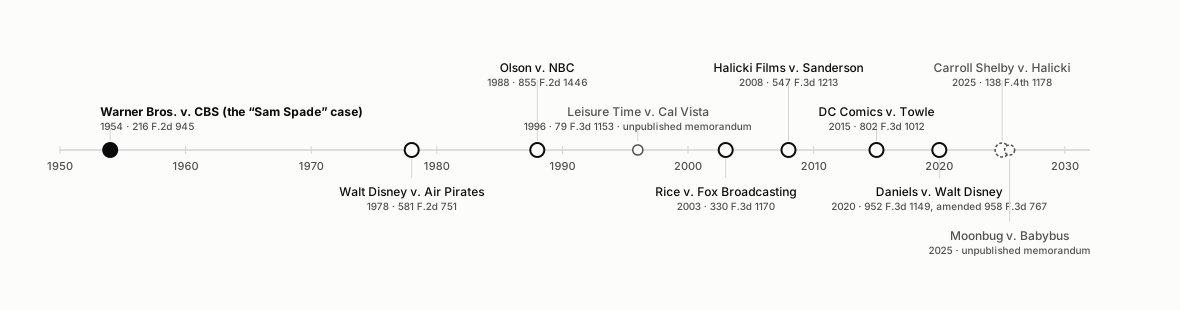
After the Sam Spade case in 1954, the Ninth Circuit published seven further opinions on the subject of character and copyright. (Leisure Time and Moonbug v. Babybus are unpublished memoranda, and Daniels v. Walt Disney has two opinions, a later opinion superseding the first, with essentially the same content. There is also Biani v. Showtime, 153 F.4th 957 (9th Cir. 2025), but Biani doesn’t touch specifically on whether a character is copyrightable.)
Interestingly, the latest relevant published Ninth Circuit opinion, Carroll Shelby v. Halicki (2025), does not mention Warner Bros. v. CBS at all, even though the 2008 Halicki opinion involving the same car did mention the Sam Spade case, and we can see this just from the raw citations.
We don’t yet know why. It could be for a number of reasons. Perhaps a later case reworded the Sam Spade case, and so the same doctrine continues under a different label. Perhaps no one in the lower courts for Carroll Shelby v. Halicki mentioned the Sam Spade case, because it’s mutually inconvenient, as Courtney Milan (Heidi Bond) pointed out on Bluesky.
What happened over the course of those 71 years? Could we find the Ninth Circuit’s current view of the Sam Spade opinion, from the texts of ~1,900 opinions alone?
Never “Overruled”
One thing was immediately clear: at no point did the Ninth Circuit say explicitly that the Sam Spade opinion had been overruled. (In fact, without sitting en banc, they are prohibited from directly overruling their own opinions. I’ll come back later to this point as a possible cause for the incoherence.)
Westlaw Edge gives the Sam Spade opinion a yellow flag, and reports “no negative direct history.” OpenJurist is worse, and marks it as “Good law” with a green checkmark and says “No negative treatment on record.”

OpenJurist’s page for Warner Bros. Pictures v. Columbia Broadcasting System, 216 F.2d 945, as captured on September 15, 2026: a green “Good law” checkmark and “No negative treatment on record.”
Both of these pieces of legal software are missing a significant amount of nuance. For example, Westlaw Edge’s KeyCite has no headnote for the “story being told” test, a significant aspect of the Sam Spade case. OpenJurist is missing many post-2015 opinions, making their charts of citations over time incorrect. I can’t really blame people for assuming that this is indicative of software as a whole.
But just below the surface is a wealth of information, if we just use it correctly.
How the Sam Spade Opinion Is Cited
The Sam Spade opinion is cited for a few different propositions, and the propositions change over time. But overall, the Sam Spade opinion has never been highly cited relative to the other Ninth Circuit opinions on the same topic:
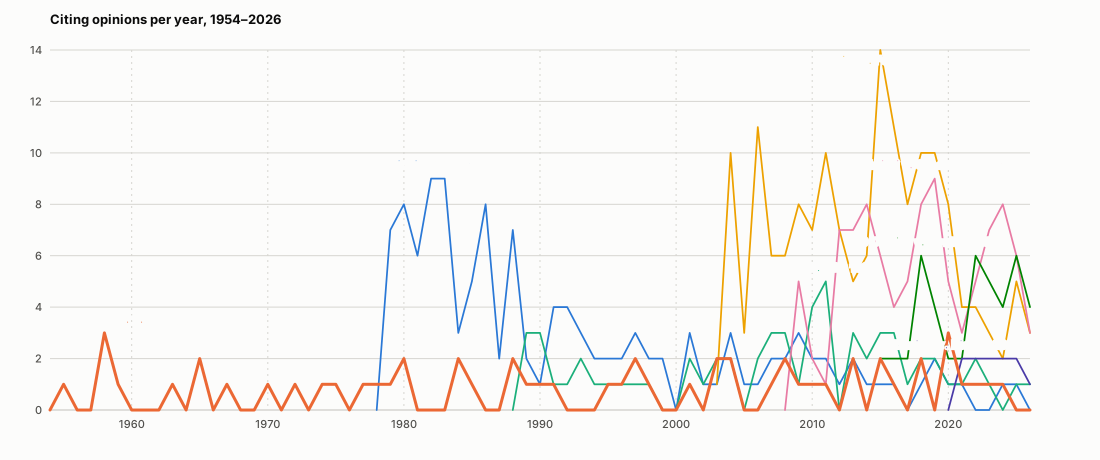
(You can download the data and code to reproduce this chart here.)
If we are going by the most naive method (unweighted raw cite counts at the case, not proposition level, from any source regardless of jurisdiction), there’s not a lot to conclude here, other than that the Sam Spade opinion doesn’t meet the criteria for being highly cited.
But, as I said originally on Bluesky, we can look at the specific propositions. We can weigh the information by who said it and what they said, what part was cited, for what argument, and the treatment at that citation. That is all information stored in the texts for anyone (including software) to see.
We can start by looking at the Ninth Circuit opinions in particular and how they talk (or decline to talk) about the Sam Spade case:
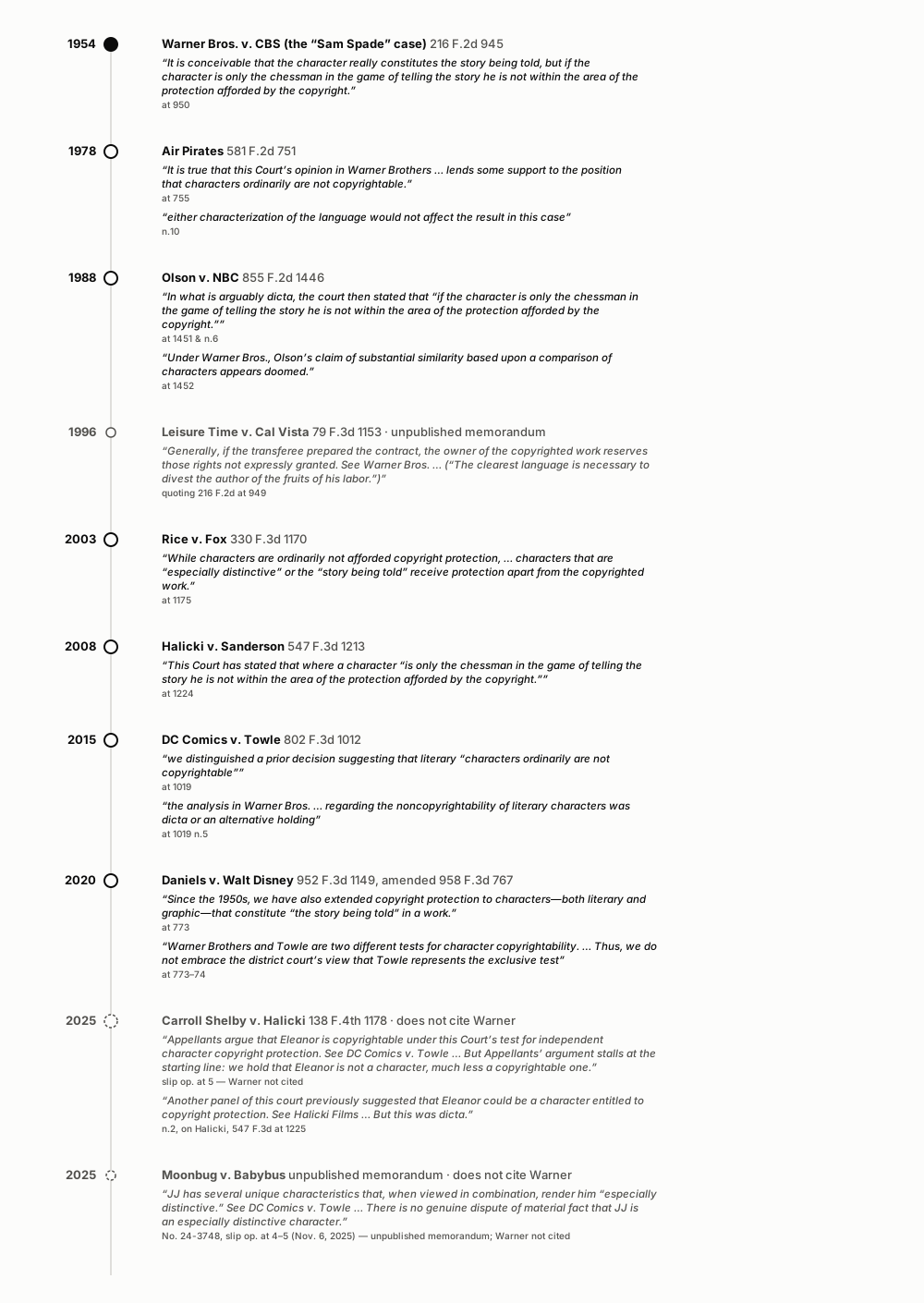
Even within just the Ninth Circuit opinions, it’s clear that the Sam Spade opinion is being cited for a few different things over time. To summarize roughly, let’s call these propositions A, B, and C.
- Characters are ordinarily not copyrightable as the default rule.
- Characters that constitute the “story being told” are copyrightable (an exception to the rule).
- By default, the author keeps the fruits of their labor.
Now let’s look at how the opinions within the Ninth Circuit and Ninth Circuit district courts cite each proposition. We will also want to look at how they cite alternative propositions from other opinions under similar fact patterns.
Walt Disney v. Air Pirates (1978)
The earliest Ninth Circuit opinion is Walt Disney v. Air Pirates (1978). At the district level in Walt Disney v. Air Pirates (1972 N.D. Cal.) the court said the Sam Spade case was “the leading case” for the proposition “that ‘characters’ as such are not generally copyrightable.” (Our Proposition A.) However, they said, “It would seem to be a narrow gap indeed which the Court left open” in the “story being told” exception (Proposition B). Interestingly, they mention “the criticism which the decision has drawn” citing Nimmer on Copyright (1963).
Then on appeal, the Ninth Circuit said that “It is true that this Court’s opinion in [the Sam Spade case] lends some support to the position that characters ordinarily are not copyrightable.” However, “[b]ecause comic book characters therefore are distinguishable from literary characters, the Warner Brothers language does not preclude protection of Disney’s characters.” In footnote 11, the court in Air Pirates said their distinction was sufficient and so declined to use the “story being told” test.
So even in 1978, we have a significant narrowing such that comic book characters are copyrightable, and the court specifically declines to use “story being told.”
Olson v. NBC (1988)
Ten years later in 1988, the Ninth Circuit in Olson v. NBC said the “story being told” test was “arguably dicta” but said that:
Even if the statements in Warner Bros. concerning the unprotectability of characters are considered to be dicta, the “Cargo” characters are not protectable even under the more lenient standards adopted elsewhere… We therefore need not resolve the issue left open in Air Pirates, 581 F.2d at 755 n. 10, whether the Warner Bros. statements should be considered dicta.
The court recalled that in Air Pirates they had previously “recognized that it is unclear whether this language is dicta or an alternate holding, but we declined to resolve the issue because Warner Bros. could be distinguished on other grounds.”
Anderson v. Stallone (C.D. Cal. 1989)
Soon afterward, Anderson v. Stallone, a Central District of California case, summarizes the situation thusly:
The Sam Spade case has not been explicitly overruled by this circuit and its requirement that a character ‘constitute the story being told’ appears to greatly circumscribe the protection of characters in this circuit.
Subsequent decisions in the Ninth Circuit cast doubt on the reasoning and implicitly limit the holding of the Sam Spade case…
This circuit’s most recent decision on the issue of copyrightability of characters, Olson v. National Broadcasting Corporation, 855 F.2d 1446 (9th Cir.1988) does little to clarify the uncertainties in this circuit as to how the Air Pirates decision affects the continued viability of the Sam Spade test.
However, Anderson appears to selectively and strangely describe Olson. Just a few paragraphs above, I explained how Olson declined to use the “story being told” test as a firm holding, but Anderson describes this same act as “cit[ing] with approval.” Anderson also fails to mention that Olson called it “arguably dicta.”
So what is originally (in my view) a pretty negative sentiment in Olson towards the Sam Spade case is laundered as positive by Anderson.
Metro-Goldwyn-Mayer v. American Honda Motor Co. (C.D. Cal. 1995)
MGM repeats Anderson almost word for word: “In Olson v. National Broadcasting Co., 855 F.2d 1446, 1451-52 n. 6 (9th Cir.1988), the court cited with approval the Sam Spade ‘story being told’ test and declined to characterize this language as dicta,” thus laundering the treatment further.
Rice v. Fox (2003)
In 2003, the Ninth Circuit in Rice v. Fox defined two tests, citing Olson and MGM:
While characters are ordinarily not afforded copyright protection, see Warner Bros. Pictures, Inc. v. Columbia Broad. Sys., 216 F.2d 945, 950 (9th Cir.1954), characters that are “especially distinctive” or the “story being told” receive protection apart from the copyrighted work. See Olson v. Nat’l Broad. Co., 855 F.2d 1446, 1452 (9th Cir.1988); Metro-Goldwyn-Mayer, Inc. v. Am. Honda Motor Corp., 900 F.Supp. 1287, 1295-96 (C.D.Cal.1995).
We can see this as restating as a live test what was previously “arguably dicta.” Thus, per Rice, if a character is “especially distinctive” OR the character is the “story being told” then the character could receive copyright protection apart from the copyrighted work.
Gaiman v. McFarlane (7th Cir. 2004, Posner)
We’ll interrupt our tour of the Ninth Circuit with Judge Posner’s analysis from the Seventh Circuit. Posner dealt with the Sam Spade case (non-binding in the Seventh) with characteristic bluntness.
“That decision is wrong,” he said in Gaiman v. McFarlane. “The Ninth Circuit has killed the decision,” he continued, “though without the usual obsequies.” He cited Olson v. National Broadcasting Co., page 1452 and n. 7 and Walt Disney Productions v. Air Pirates at 755 and n. 11 as evidence.
Interestingly, Posner and the Anderson court read the same two opinions, the same pages, and adjacent footnotes, and came to completely different conclusions:
| Anderson v. Stallone (C.D. Cal. 1989) | Gaiman v. McFarlane (7th Cir. 2004) |
|---|---|
| Olson 1451–52 n.6: “we recognized that it is unclear whether this language is dicta or an alternate holding, but we declined to resolve the issue” | Olson 1452 and n.7: “We therefore need not resolve the issue left open in Air Pirates … whether the Warner Bros. statements should be considered dicta” |
| Air Pirates at 755: “the Warner Brothers language does not preclude protection of Disney’s characters” | Air Pirates at 755 and n.11: “we need not endorse the district court’s conclusion that Disney’s characters fell within the Warner Brothers exception” |
| Anderson Verdict: “cited with approval … and declined to characterize this language as dicta” | Gaiman Verdict: “The Ninth Circuit has killed the decision … though without the usual obsequies” |
A New Definition of Dicta (2005)
One more detour before we get back to copyright: as Claude helpfully pointed out to me, in 2005, the Ninth Circuit, sitting en banc in Barapind v. Enomoto, changed their working definition of dicta. This was the conclusion of a process that had started earlier in United States v. Johnson in 2001.
In an article, Professor Charles W. Tyler calls this new definition the “adjudicative model”. He says the adjudicative model “treat[s] a ruling as authoritative if it expressly resolved an issue that was part of the case,” which a judge he interviewed said proposed a substantial “expansion of the concept of a holding.”
As a Johnson concurrence put it: “[W]here a panel confronts an issue germane to the eventual resolution of the case, and resolves it after reasoned consideration in a published opinion, that ruling becomes the law of the circuit, regardless of whether doing so is necessary in some strict logical sense.”
In the article, Professor Tyler categorizes subsequent Ninth Circuit cases by whether they followed, contravened, or distinguished prior cases.

Figure 1, “Percentage of Ninth Circuit Case Treatments, by Year,” from Charles W. Tyler, The Adjudicative Model of Precedent, 87 U. Chi. L. Rev. 1551, 1578 (2020). Reproduced from the article.
Tyler says,
The increase in DISTINGUISH cases shouldn’t surprise us. A judge who seeks to circumvent an earlier case can do so in one of three ways: (1) overrule it, (2) say that the relevant portion of the case is dicta, or (3) distinguish the case on its facts. In the Ninth Circuit, option (1) is unavailable because three-judge panels may not overrule prior Ninth Circuit decisions. That leaves options (2) and (3). The adjudicative model limits the circumstances in which a court can use option (2), which one might predict would increase the frequency with which judges will use option (3). And that’s what the data suggest. Nonetheless, the DISTINGUISH cases don’t simply replace the cases that would have been coded CONTRAVENE under the necessity model. Indeed, as explained more fully below, the increase in FOLLOW cases alone was highly significant, suggesting that a substitution of CONTRAVENE cases for DISTINGUISH cases isn’t the whole story.
He goes on to say it appears that the Ninth Circuit did actually change behavior and was more likely to follow prior decisions, controlling for several variables.
Tyler breaks down the issue in a very helpful way. If we assume for the sake of argument that the Ninth wanted to ditch the Sam Spade test, it could:
- overrule it,
- call it dicta, or
- distinguish it based on the facts.
However, it couldn’t overrule with only a three-judge panel, and it might not get the votes for en banc. And now, it couldn’t easily analyze afresh and call the Sam Spade test dicta, since, in my opinion, the “story being told” analysis expressly resolved an issue that was part of the case.
So we would expect, going forward, that if the Court still did not like the Sam Spade test, it would attempt to distinguish, that being the only remaining valid option. Furthermore, we had previously seen the Ninth Circuit use this strategy in Air Pirates, where comic book characters were distinguished from literary characters.
Halicki v. Sanderson (2008)
In the next relevant Ninth Circuit case, the court restated the prior history and then “remanded to the District Court for a finding in the first instance as to whether Eleanor [the car character in question] is entitled to copyright protection. On remand the court should examine whether Eleanor’s ‘physical as well as conceptual qualities [and] … unique elements of expression’ qualify Eleanor for copyright protection.” The court did hint that “The Eleanor character can be seen as more akin to a comic book character than a literary character.” (Because the court remanded, their analysis of the copyrightability and character qualities would likely be dicta under both the pre- and post-Barapind definitions.)
DC Comics v. Towle (2015)
In Towle, the Ninth Circuit never mentions the “story being told” test, and instead creates a new three-prong test “for determining whether a character in a comic book, television program, or motion picture is entitled to copyright protection.” We should note that test’s intended categories leave out purely literary characters.
Moreover, the first prong, that the character “must generally have ‘physical as well as conceptual qualities,’” also seems to exclude many purely literary characters.
In simplified form, the three prongs are:
- Have physical as well as conceptual qualities
- Be sufficiently delineated
- Be especially distinctive
Interestingly, regarding the Sam Spade test, Towle does not reassess whether it was dicta in light of Barapind. Instead, they side-step by merely quoting historical words:
We later indicated that the analysis in Warner Bros. Pictures, Inc. v. Columbia Broad Syst., Inc., regarding the noncopyrightability of literary characters was dicta or an alternative holding.
Daniels v. Walt Disney (2020)
At this point, perhaps we’re thinking we have enough evidence to conclude that the Sam Spade test was “silently overruled.”
However, in Daniels v. Walt Disney, the Ninth Circuit makes the “story being told” test live again.
Whereas Air Pirates sought to distinguish between literary and comic book characters, the court in Daniels applies the “story being told” test to both literary and graphic characters:
Since the 1950s, we have also extended copyright protection to characters—both literary and graphic—that constitute “the story being told” in a work.
The court then cites the Sam Spade test as a live, available test for character copyrightability.
Warner Brothers and Towle are two different tests for character copyrightability. See Rice, 330 F.3d at 1175 (“characters that are ‘especially distinctive’ or the ‘story being told’ receive protection apart from the copyrighted work” (emphasis added)). Thus, we do not embrace the district court’s view that Towle represents the exclusive test for copyrightability. The Warner Brothers test is therefore available, but it affords no protection to The Moodsters.
And the court concludes: “The Moodsters are mere chessmen in the game of telling the story.”
So if we thought that the “story being told” test had been silently overruled earlier (killed, as Posner said), it certainly isn’t in 2020 via Daniels. And the earlier attempt to say that Towle was the exclusive test for graphic characters? That was gone too.
But while Daniels reaffirmed the viability of the Sam Spade test, it also made it much weaker than the original form. The original form claimed there is no protection unless the character is the story. Having the second test as an alternative path meant that this broad statement was not the default assumption.
The Reaction to Daniels
The district courts subsequently interpreted Daniels as reaffirming the “story being told” test and applied or acknowledged it:
| Opinion | What it said |
|---|---|
| Ricketts v. CBS, C.D. Cal. No. 2:19-cv-03895, Mar. 19, 2020 (ECF 125, reconsideration denied) | “The Ninth Circuit did recently issue a decision analyzing the ‘story being told’ line of character copyright protection. Daniels v. Walt Disney Co. … (‘Since the 1950s, we have also extended copyright protection to characters—both literary and graphic—that constitute “the story being told” in a work’). However, Plaintiff does not contend (nor could he) that this case evidences any material change in law.” (at 10) |
| ZAG America v. Harasymets, C.D. Cal. No. 2:21-cv-05100, June 3, 2022 (ECF 34, default judgment) | “Nor has Plaintiff alleged that the characters ‘Ladybug’ and ‘Cat Noir’ constitute ‘the story being told’ in a work.” … There are no allegations that the characters ‘so dominate the story such that it becomes essentially a character study.‘” (at 8) |
| Carroll Shelby Licensing v. Halicki, C.D. Cal. No. 8:20-cv-01344, Nov. 29, 2022 (ECF 350, summary judgment) | “Copyright protection also extends to characters under an alternative ‘story being told’ test. Daniels v. Walt Disney Co., 958 F.3d 767, 773–74 (9th Cir. 2020). Because the parties do not advance a theory of copyrightability under the test, the Court assumes that Eleanor does not meet it.” (at 8 n.8) |
| Gilbert-Daniels v. Lions Gate, C.D. Cal. No. 2:23-cv-02147, Dec. 7, 2023 (ECF 133, summary judgment) | “characters are often ‘only … chessman in the game of telling the story.’ … Such ‘chessmen’ characters are not afforded copyright protection. … Put another way, when ‘the character really constitutes the story being told,’ such a character is entitled to protection.” (at 32) |
| Biani v. Showtime Networks, C.D. Cal. No. 2:23-cv-03845, Mar. 29, 2024 (ECF 23, motion to dismiss) | “The Ninth Circuit has articulated two tests … the ‘story being told’ test and the so-called ‘Towle’ test.” … “While Daniels recently reaffirmed the continued existence of the Ninth Circuit’s ‘story being told’ test, it is a remnant of an older approach to copyright law.” (at 3–4) |
Carroll Shelby Licensing, Inc. v. Halicki (2025)
Now we’ve finally gotten to the most recent relevant published Ninth Circuit opinion, Carroll Shelby Licensing, Inc. v. Halicki, 138 F.4th 1178.
When the case was appealed to the Ninth, the Ninth only applied the Towle test and did not mention the “story being told” test at all. As you can see in the table above, the lower court for this case had mentioned the “story being told” test, but dropped it because no party advanced a theory of copyright under the test. And importantly, we learned this from the text itself, from the district court’s footnote 8.
But if we look closely, we can see that the Ninth Circuit is not merely dropping the Sam Spade test due to lack of argument. The default rule and the exception have changed places somewhere since 1954. In the Sam Spade case, the default was that characters (type not mentioned) were ordinarily not copyrightable, with the exception being characters that constitute the “story being told.” In Carroll Shelby, the court restates Towle’s framing, saying that the default is that graphically-depicted characters are historically able to be copyrighted, but there are exceptions such that it is NOT copyrightable (“not every comic book, television, or motion picture character is entitled to copyright protection”).
Conclusions
It does not seem like the Sam Spade case is “silently overruled.” Daniels v. Walt Disney (2020) made it clear it was an available test, and the text of the district court opinion in Carroll Shelby (2022) states that an argument using the Sam Spade test simply was not made by the parties. So we don’t have clear evidence that the Ninth Circuit intended to currently exclude it. However, the default assumption and the exceptions for copyrightability of characters have silently changed over time into something very different.
Mike was right that “Technically, legally, [the Sam Spade case] still is good law for the core proposition.” However, it’s not quite accurate to say “They just stopped applying that test.” The Ninth declined to decide whether it was dicta or not, but kept referencing it in Rice (2003) and Halicki (2008). They then fully affirmed it in the 2020 case, Daniels, the case Mike had remembered.
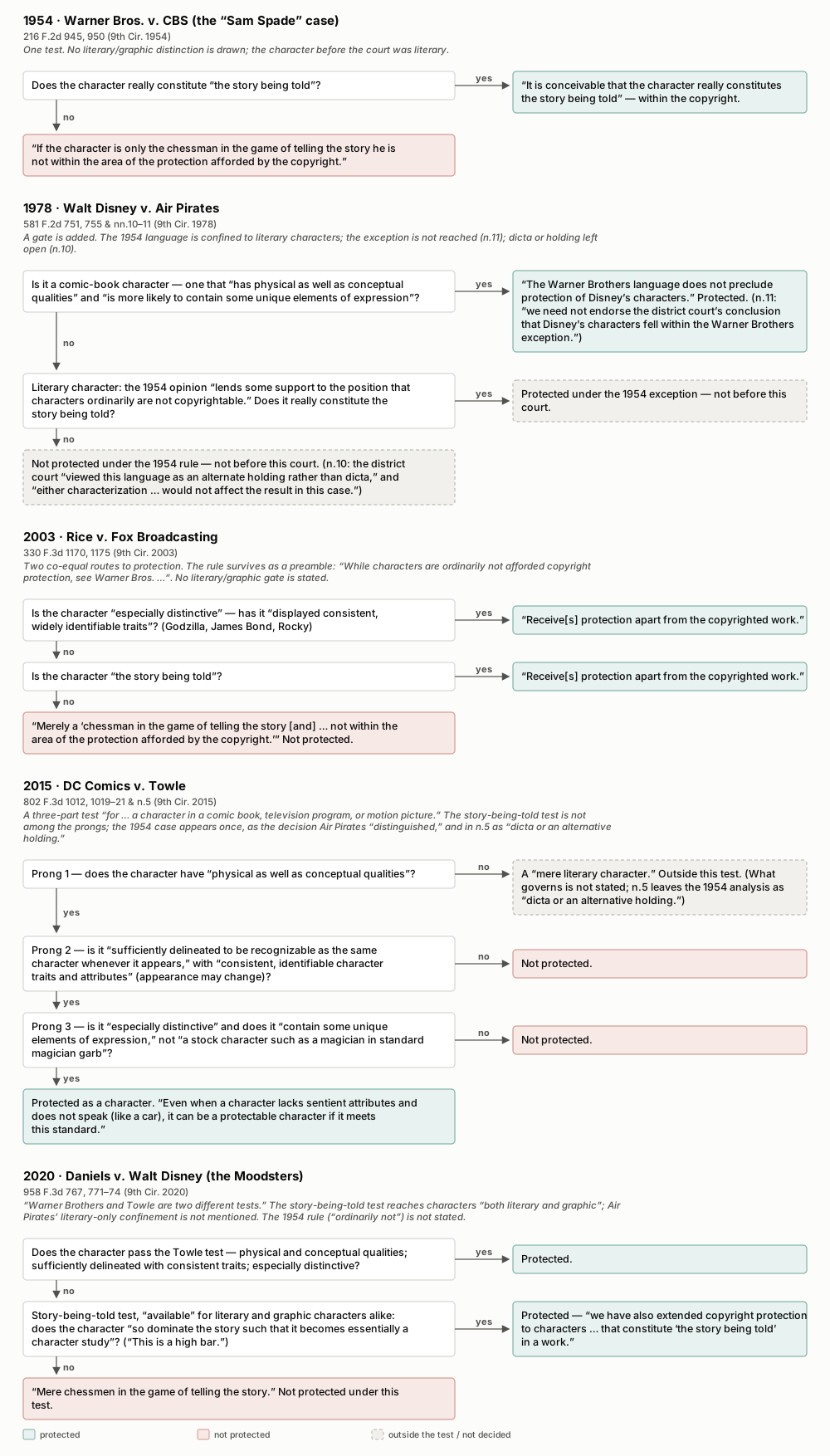
Lastly, with regard to Mike’s statement that “You can kind of trace the shift away, but you have to be very familiar with that area of law,” I think it’s not as murky as it might be without software. Seeing the cases on a timeline, seeing the citing paragraphs directly in connection with each other, all helps to gather context. Claude also made this very helpful flowchart that explains the different tests as applied by each decision:
Potential Indicators
Even though the Sam Spade case was never highly cited, and even though it is not silently overruled now, it’s still a useful exercise to look for the textual indicators that a court may not look on a prior decision with favor.
We saw a few of them earlier:
- When a proposition is often being called “dicta” (although that signal may be less available in the Ninth after Barapind).
- When a case is mentioned only to distinguish it.
- When a proposition is introduced then immediately followed with a “nevertheless” or some other word that indicates moving past it, as in Air Pirates.
There are also potential confounders, which we saw, such as the parties choosing not to use an argument, the same test being smuggled in via a cite to a later opinion, or the opinion restating in its own words without citing.
I realized when writing this that what I was calling indicators or factors are really features in computer science. Features are anything that could potentially be used to shift the probabilities of a label. For instance, if we were trying to label an animal as a dog or cat, we might have a list of features like “barks” and “meows” and “is fluffy.” A counterexample such as a mute dog or a hairless cat wouldn’t negate the overall value of the feature list, since the features are considered together as a whole, each with different weights. The confounders I mentioned earlier are where the feature fires without the label being true, which is fine if we are not relying on any one feature.
A full study would need to be done to see how useful these indicators are, and whether there are any others, but I think it is clear that we can derive a lot from the text, and the idea that identifying “silently overruled” opinions via the text is “intractable” is an extreme statement that is likely wrong. We don’t need to go outside the texts, the texts being the published opinions and the lower-court orders, all potentially available and public.